Art

Chinese Fan Calligraphy

Calligraphy was the highest art of the Chinese scholar — and the fan made it portable. Learn the scripts, the composition rules and how to read a calligraphed fan.

Chinese fan with landscape painting and calligraphy

In this guide, “Chinese fan” refers to the traditional hand fan (扇子) — not fan culture or the surname Fan.

What this guide covers

The outline

  1. 01Why calligraphy on a fan?
  2. 02Scripts: running, standard and seal
  3. 03Composing to the fan's curve
  4. 04Famous calligraphed fans
  5. 05How calligraphy fans are made
  6. 06Buying a calligraphy fan
  7. 07Frequently asked questions

Section 01

Why calligraphy on a fan?

Calligraphy was the highest art of the Chinese scholar — more respected, in many periods, than painting. Putting it on a fan made that art portable: a poem written in good brushwork could be carried in the sleeve, shown to a friend, or given as a gift. The fan became a mobile gallery of the written word.

On the classic literati fan, calligraphy and painting share the leaf: an image on one side, a poem on the other, or a poem tucked into the empty space of a landscape. Together they form the complete object described in Chinese fan art.

Section 02

Scripts: running, standard and seal

ScriptChineseCharacter
Running script行书 xíngshūFlowing but legible — the most common fan script
Standard script楷书 kǎishūClear and formal; poems written for respect
Cursive script草书 cǎoshūExpressive and fast; admired by connoisseurs
Seal script篆书 zhuànshūAncient, decorative; rare on fans, common on seals
Chinese scripts commonly found on fans

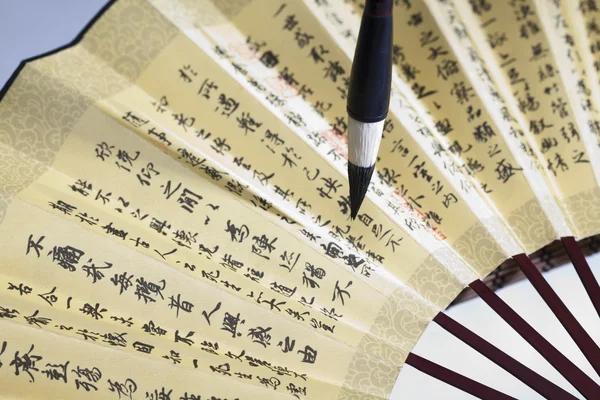
Running script dominates because it balances art and readability — important when the poem is meant to be read. Standard script appears on more formal or respectful pieces, and cursive script is for display rather than quick reading. The artist's red seal (印章, yìnzhāng) completes the composition.

Section 03

Composing to the fan's curve

Writing on a folding fan is a special discipline. The text follows the ribs, so each column is narrow and slightly angled outward, and the calligrapher must fit the lines to the arc — long poems flow across the upper half, shorter inscriptions sit below a painting. On a round fan, the writing is arranged in a block or around the circle, leaving the center free.

The result is that calligraphy and fan shape are inseparable: a poem written on a folding fan looks wrong on a round one. That is why a genuine calligraphed fan feels designed, while a printed copy often looks generic. For spotting the difference, see buying a calligraphy fan below.

Section 04

Famous calligraphed fans

The greatest calligraphed fans come from the Ming and Qing literati. Wen Zhengming — equally famous as painter and calligrapher — left fans that pair precise running script with his landscapes. Dong Qichang, the theorist and calligrapher, wrote fans that became models for later scholars. Their works survive in museums, usually detached from the ribs and mounted in albums.

The cultural moment behind these fans is the Ming dynasty, when the folding fan became the scholar's signature and writing on it was a daily practice rather than a special event.

Section 05

How calligraphy fans are made

  • The leaf is prepared — paper sized, silk mounted — so ink sits on the surface.
  • The text is composed to the fan's arc, line by line, following the ribs.
  • The calligrapher writes with brush and ink; mistakes are not erasable.
  • A red seal (印章) is stamped to balance the composition and authenticate the work.
  • The leaf is folded and mounted onto bamboo, sandalwood or wooden ribs.

Because every step is handwork, a calligraphed fan is one of the most personal objects in the craft. The materials follow the same rules as other fans — see the bamboo fan and silk fan guides.

Section 06

Buying a calligraphy fan

  • Check whether the writing is hand-brushed: real ink strokes vary in width and show the brush's rhythm.
  • Look for a red seal — printed reproductions usually lack one or print it flat.
  • Ask whose calligraphy it is; a named calligrapher changes the value completely.
  • Read the text: a genuine fan carries a real poem or phrase, not random characters.
  • Expect handwork to cost more — see handmade Chinese folding fans.

For the full authentication process — materials, ribs, painting and provenance — start with authentic Chinese folding fans.

Section 07

Frequently asked questions

What is Chinese fan calligraphy?

Chinese fan calligraphy is the tradition of writing poems and phrases on the surface of a round or folding fan. It is considered part of Chinese fan art and is usually paired with painting on the same leaf.

Why is calligraphy written on fans?

Calligraphy was the highest art of the Chinese scholar, and the fan made it portable and personal — a poem could be carried in the sleeve, shown to friends or given as a gift.

What script is used on Chinese fans?

Running script (行书) is the most common because it is both expressive and readable. Standard script (楷书) appears on formal pieces, cursive script (草书) on display pieces, and seal script mainly on the artist's seal.

How can you tell a hand-written fan from a printed one?

Hand-written fans show real ink strokes with varying width and brush rhythm, and usually carry a red seal stamped with genuine pressure. Printed reproductions have flat, uniform lines and often no authentic seal.