History

Chinese Fans in the Ming Dynasty

In the Ming dynasty, Chinese fans became the scholar's signature: folding fans carried in the sleeve, painted by the great Wu School masters, and exchanged as tokens of friendship. Here is the story of the fan's golden age.

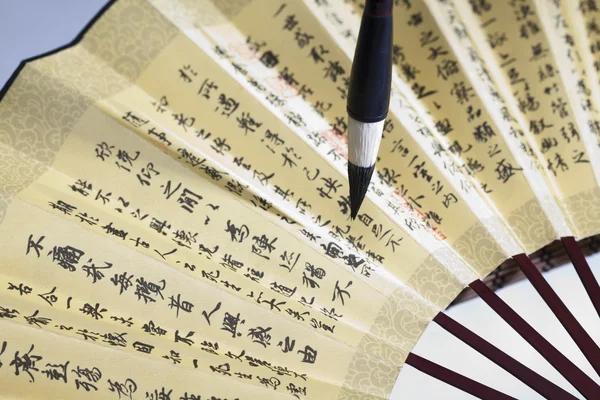
Chinese fan decorated with landscape painting and calligraphy

In this guide, “Chinese fan” refers to the traditional hand fan (扇子) — not fan culture or the surname Fan.

What this guide covers

The outline

  1. 01Fans as social currency in Ming society
  2. 02The scholar-official and his folding fan
  3. 03Famous Ming fan painters
  4. 04Fans as gifts and tokens of friendship
  5. 05How Ming fans were made
  6. 06Frequently asked questions

Section 01

Fans as social currency in Ming society

In the Ming dynasty, a Chinese fan was more than an accessory — it was social currency. A scholar's folding fan signaled education, taste and membership in the literate world, and the quality of a fan could be read as easily as a signature. Carrying the right fan said as much about a man as his calligraphy.

Fans appeared everywhere in Ming life: in portraits, where officials and literati are shown holding them; in painting, where the fan itself became a canvas; and in daily etiquette, where opening, waving and closing a fan were all small performances. The history of Chinese fans places this moment in the longer arc — the Ming was the folding fan's golden age.

Section 02

The scholar-official and his folding fan

The Ming scholar-official made the Chinese folding fan his own. Closed, it slipped into the sleeve of his robe — the source of the nickname 怀袖雅物 (huáixiù yǎwù), “a refined object for the sleeve.” Open, it displayed a landscape, a poem or a branch of plum painted by the man himself or by a friend.

The fan was also a working tool of social life. At gatherings of scholars, exchanging fans was a way of sharing art and opinion; a fan painted for a specific person was a direct compliment. This is why so much Chinese fan art from the Ming feels personal — it was made to be given, carried and remembered.

Section 03

Famous Ming fan painters

  • Shen Zhou (沈周) — the senior master of the Wu School, whose landscapes on fans set the standard for literati brushwork.
  • Wen Zhengming (文徵明) — painter and calligrapher whose fans pair precise landscapes with poetry in running script.
  • Tang Yin (唐寅) — the most famous name of the school, known for graceful figures and elegant, effortless compositions.
  • Chen Chun (陈淳) — master of freehand flower painting, whose ink plum and orchid appear on many surviving fans.

All four worked in the Suzhou area, which was the center of Ming painting and fan-making at once. Their surviving fan paintings — usually detached from the ribs and mounted in albums — are the foundation of the Chinese fan painting tradition we know from museums today.

Section 04

Fans as gifts and tokens of friendship

Ming fans were the standard gift of the literati. A painted fan said something a letter could not: it was a work of art made for one person, carrying an image or poem chosen for them. Friends exchanged fans at parting, and collectors kept albums of fan faces (扇面) as records of their relationships.

The custom connects directly to modern Chinese fan gift practice — the idea that a fan carries a message. In the Ming it was already understood that the motif and the calligraphy were the real gift; the ribs and silk were only the frame around them.

Section 05

How Ming fans were made

  • Ribs — split and shaped from bamboo, or carved from sandalwood and rare woods for finer fans.
  • Leaf — paper or silk, cut to the fan's arc and sized so ink would not bleed.
  • Painting and writing — the leaf was decorated before or after mounting, usually by hand.
  • Mounting — the leaf was pleated, glued to the ribs and fixed at the rivet with the guard sticks.
  • Finishing — a tassel or carved rivet cap completed the fan.

Suzhou and Hangzhou were the great production centers, and their workshops divided the work between rib carvers, leaf painters and mounters. The same division of labor, with the same cities, survives in the handmade Chinese folding fans made today.

Section 06

Frequently asked questions

Why were fans important in the Ming dynasty?

In the Ming dynasty the folding fan became the signature accessory of the scholar class. It signaled education and taste, carried painting and calligraphy, and was exchanged as a personal gift between friends.

What kind of fan did Ming scholars carry?

Ming scholars carried folding fans (zhéshàn) with bamboo ribs and painted paper or silk leaves. The fan folded into the sleeve, which earned it the nickname “a refined object for the sleeve.”

Which Ming artists painted fans?

The Ming Wu School masters — Shen Zhou, Wen Zhengming, Tang Yin and Chen Chun among them — painted fans as seriously as scrolls. Their fan paintings survive in museums, usually mounted in albums.

Where were Ming fans made?

Suzhou and Hangzhou were the main production centers. Workshops divided the craft among rib carvers, painters and mounters — the same structure that survives in today's handmade fan workshops.