Section 01
When folding fans first appeared in China
Chinese records place the folding fan at the Song court well before it became a native classic. The zhéshàn (折扇) — literally “the fan that folds” — appears in Song sources as an object carried by envoys and courtiers, and its collapsible pleats were the novelty that caught attention in a culture still dominated by fixed round fans.
That early arrival mattered less than the transformation that followed. Chinese makers took the imported idea, rebuilt it with bamboo, paper and silk, and turned a court curiosity into the most Chinese of fans. The Chinese folding fan page explains the finished object; this page traces how it got here.
Section 02
Debated origins: China, Japan or Korea?
Ask who invented the folding fan and historians will give you three answers: China, Japan and Korea. Japan has the hiōgi (桧扇), a fan of thin cedar slats that folds, and Korean tradition has the hapjukseon (合竹扇), a folding fan of split bamboo. Chinese records describe folding fans arriving with tribute missions from both neighbors during the Song dynasty, which is the strongest evidence we have for an East Asian exchange rather than a single birthplace.
The honest summary is that the folding fan developed somewhere in East Asia, travelled through tribute and trade, and was perfected in China — where it became an art form. That is why museum labels often say “folding fan, China, Ming dynasty” without claiming a first inventor: by the time the fan matters to history, it is already Chinese.
Section 03
The folding fan in literati culture
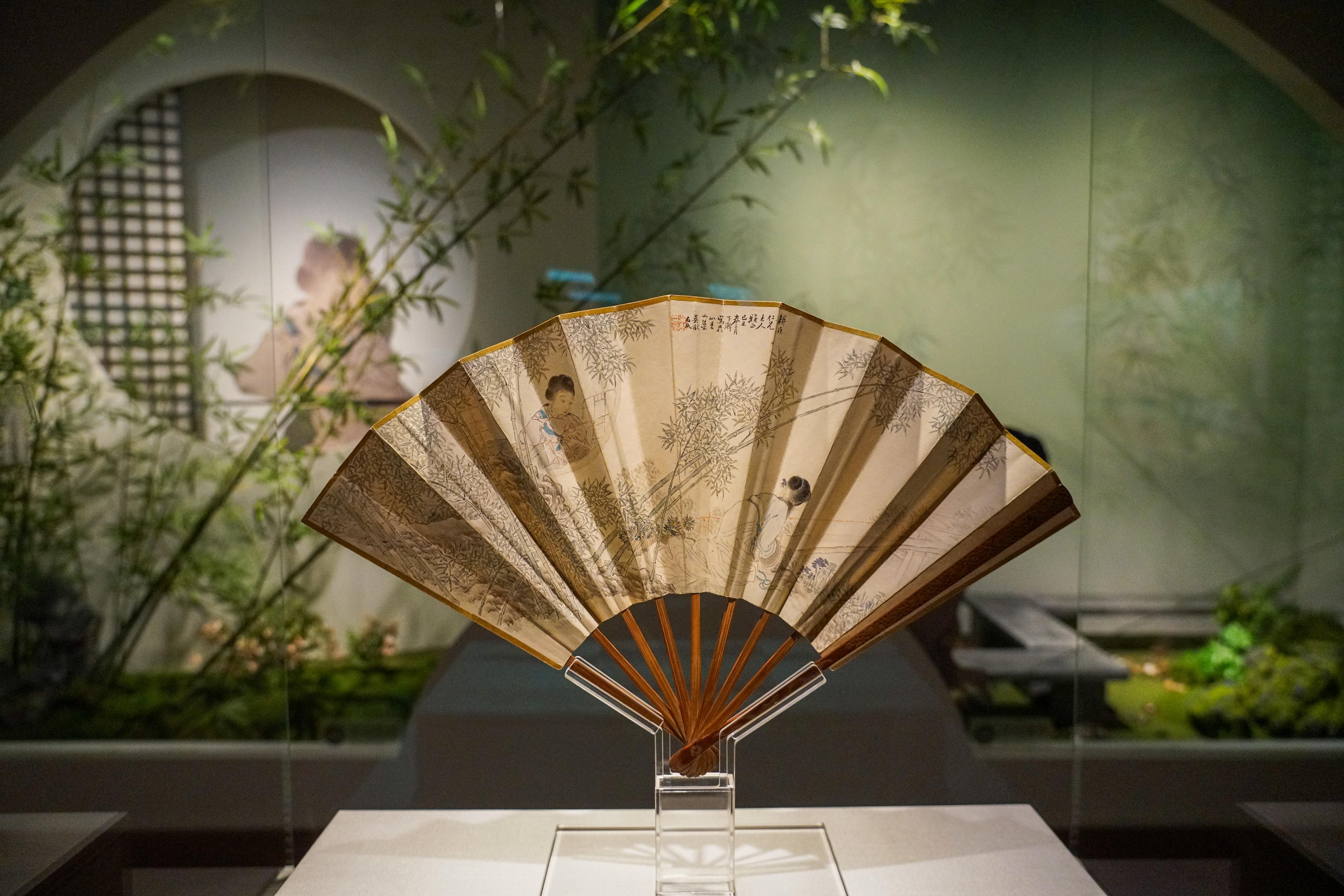
The Ming literati adopted the folding fan the way a movement adopts a uniform. It fit the sleeve, opened with one hand, and — crucially — gave every scholar a small surface on which to paint or write. A fan became a tiny scroll, and painting and calligraphy on fans turned the object into a medium.
Fans also became social instruments. Scholars exchanged painted fans as gifts and tokens of friendship, and the quality of a man's fan — its ribs, its painting, even the way he held it — was read as a statement of taste. The nickname 怀袖雅物 (huáixiù yǎwù), “a refined object for the sleeve,” says everything about how the fan felt to its owner.
Section 04
Ming and Qing golden age
By the Ming and Qing dynasties the folding fan had its own craft economy. Suzhou and Hangzhou produced the best ribs and leaves, with bamboo as the everyday material and sandalwood, ivory and rare woods for the luxury market. Rib carvers, leaf painters and calligraphers each had their trade, and a fine fan could cost more than a month of an artisan's wages.
The Qing court took the fan further, commissioning carved and gilded examples as gifts and status objects. Antique folding fans from this period — with carved sandalwood, ivory or lacquered ribs — are the pieces collectors still chase today. The era's full picture is in Chinese fans in the Ming dynasty and Chinese fans in the Qing dynasty.
Section 05
How folding fans spread to Europe
European traders met the folding fan in the 16th century, and by the 18th century Canton workshops were producing fans specifically for export — painted leaves, sometimes with European-style figures, packed in boxes for ships bound for Europe. The “Chinese fan” became a fashionable accessory at European courts and appears in countless portraits of the period.
That export trade is also why so many early Chinese fans survive in European and American museums today: thousands were shipped west, and the best examples were preserved as curiosities. For collectors, a nineteenth-century export fan is often the most affordable entry into the history — a genuine piece of the tradition with a documented journey. See Chinese folding fans for sale for what to look for.
Section 06
Frequently asked questions
Who invented the folding fan?
There is no single agreed inventor. Japan, Korea and China all have folding-fan traditions, and Chinese records show folding fans arriving with tribute from Japan and Korea during the Song dynasty. Chinese workshops then perfected it into the painted literati fan of the Ming dynasty.
When did folding fans appear in China?
Folding fans appear in Chinese records from the Song dynasty, arriving through tribute and trade with Japan and Korea. They became widely popular among scholars in the Ming dynasty.
Why did Ming scholars carry folding fans?
The folding fan was practical — it collapsed into the sleeve — and artistic, offering a small surface for painting and calligraphy. It also signaled education and taste, which is why it became the scholar's signature accessory.
How did Chinese folding fans reach Europe?
Folding fans reached Europe through trade from the 16th century, and Canton workshops exported painted fans in large numbers from the 18th century. The “Chinese fan” became a fashionable accessory at European courts.