Section 01
What a fan itself symbolizes
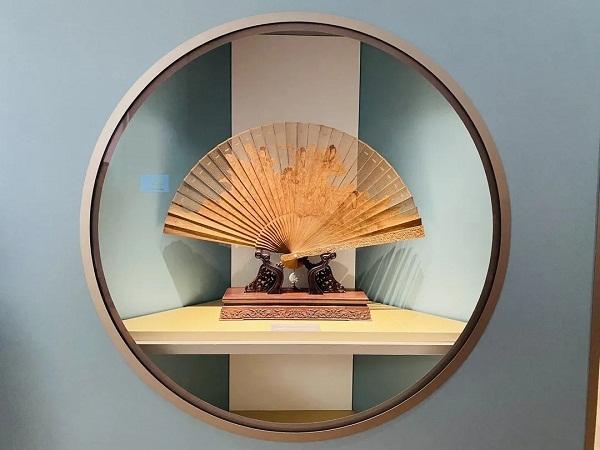
Before any motif is painted on it, the fan itself carries meaning. In Chinese culture a fan signals education and taste — the scholar's folding fan was a portable badge of learning — and it is also a gesture of courtesy: fanning a guest, or offering a fan as a gift, is an act of respect.
Folk tradition adds a caution. Because shàn (扇, “fan”) sounds close to sàn (散, “to part”), an old saying warns against giving a fan as a farewell gift — it could be read as “may we part.” That is why the meaning of a fan depends so much on the occasion, which is exactly what our Chinese fan gift guide explores.
Section 02
Flowers: lotus, plum, peony, orchid
Flowers are the most common language on painted fans, and each bloom is a word. The lotus rises from the mud to open clean and white, so it stands for purity and integrity. The plum blossom blooms in late winter, so it stands for resilience and hope. The peony is the “king of flowers,” a symbol of wealth and honor, while the orchid represents the quiet elegance of the scholar.
- Lotus (莲花) — purity; rising unstained from the mud.
- Plum blossom (梅花) — resilience; the first flower of spring.
- Peony (牡丹) — wealth, honor, prosperity.
- Orchid (兰花) — refinement, the scholar's flower.
- Chrysanthemum (菊花) — longevity and the contented recluse.
For the full visual dictionary, including which flower to choose for which person, see Chinese fan motifs.
Section 03
Birds and animals: crane, phoenix, fish
Birds and animals on fans nearly always work by symbolism or wordplay. The crane is the bird of long life, often painted with a pine tree. The phoenix (fènghuáng) represents harmony and virtue, and pairs naturally with the dragon as the two great mythical beings. Fish are popular because 鱼 (yú, “fish”) sounds like 余 (yú, “surplus”) — a wish for abundance.
- Crane (鹤) — longevity.
- Phoenix (凤凰) — harmony, virtue, the empress.
- Dragon (龙) — power, authority, the emperor.
- Fish (鱼) — abundance, because yú sounds like “surplus.”
- Bat (蝠) — fortune, because fú sounds like “blessing.”
- Mandarin ducks (鸳鸯) — love and a happy marriage.
Section 04
Landscape and calligraphy
Not every fan is decorated with a single symbol. Many literati fans carry a landscape — mountains and water — which in Chinese art means retreat, nobility and the scholar's inner world. Others carry only calligraphy: a poem or a phrase, chosen for what it says. A fan written with a blessing is a direct message from the giver to the receiver.
The most celebrated combination is the Three Friends of Winter (岁寒三友, suìhán sānyǒu): pine, bamboo and plum, painted together because all three stay green or bloom through the cold. It is a compact statement of endurance and integrity — and one of the most common themes on both Chinese fan painting and Chinese fan calligraphy.
Section 05
Fans as gifts and tokens
Because a fan can carry a message, giving one is a way of speaking without words. A fan with peonies wishes prosperity; one with cranes and pine wishes long life; one with mandarin ducks or a double-happiness mark (囍) celebrates a marriage. The practice connects directly to Chinese fan traditions of gift-giving, where the motif matters as much as the fan itself.
The rule for giving is simple: match the motif to the person and the occasion. A young scholar receives bamboo or orchid; a couple celebrating a wedding receives mandarin ducks or peonies; an elder receives cranes and pine. More pairings are in the Chinese fan gift guide.
Section 06
How to read a fan's message
- Start with the motif — flower, bird, animal or landscape — and ask what it stands for.
- Look for wordplay: fish for surplus, bat for fortune, deer for emolument.
- Check combinations: pine + crane = longevity; lotus + fish = abundance each year.
- Read any calligraphy — the poem or phrase often states the wish directly.
- Notice the format: a round fan carries a centered image; a folding fan follows the arc.
If you are choosing a fan for yourself, there is no wrong answer — but knowing what you are carrying makes the fan feel like yours. Start with what a Chinese fan means for the general question, or jump straight to the motif dictionary.
Section 07
Frequently asked questions
What does a Chinese fan symbolize?
A Chinese fan symbolizes education, taste and courtesy — the scholar's folding fan was a badge of learning, and offering a fan is a gesture of respect. Painted motifs add specific wishes: lotus for purity, peony for wealth, crane for longevity.
What do flowers on Chinese fans mean?
Each flower carries its own meaning: lotus means purity, plum blossom means resilience, peony means wealth and honor, orchid means refinement, and chrysanthemum means longevity.
What is the Three Friends of Winter?
The Three Friends of Winter (岁寒三友) are pine, bamboo and plum, painted together because they endure or bloom through winter. Together they symbolize endurance, integrity and resilience.
What kind of fan should I give as a gift?
Match the motif to the occasion: peonies or mandarin ducks for a wedding, cranes and pine for long life, plum blossom for a new year, and bamboo or orchid for a student or scholar. See the Chinese fan gift guide for details.